The Monogrammed Moment: Why Affluent Americans Are Choosing Stories Over Status Symbols
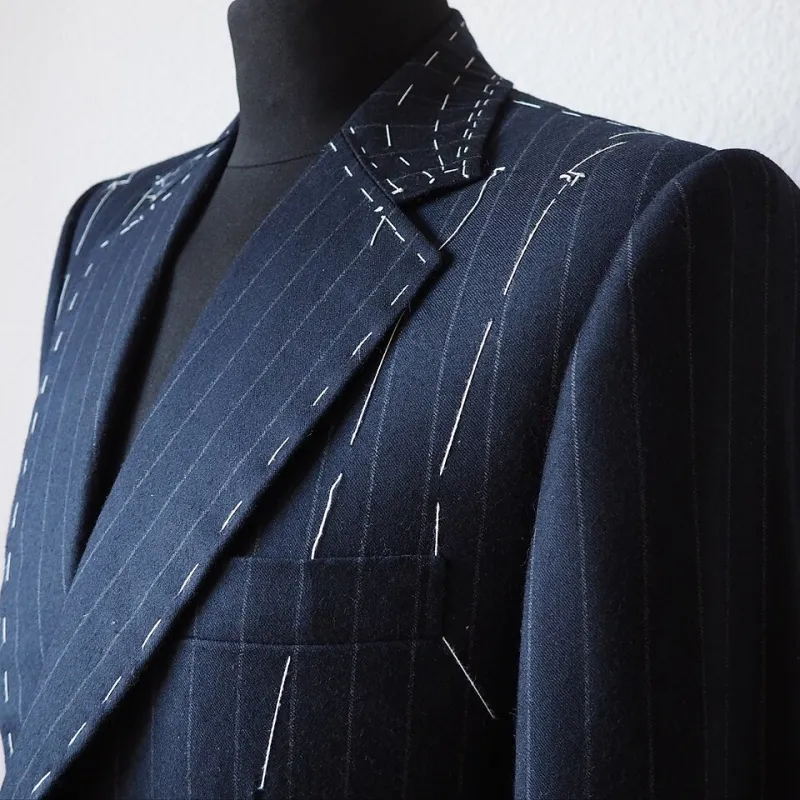
Photo: Sven Krolczik, CC BY-SA 4.0, via Wikimedia Commons
Consider two men at a dinner in the West Village. Both wear beautifully cut navy blazers. One is from a well-regarded Italian house, purchased off the rack at a Madison Avenue flagship. The other began as the same base garment but was subsequently altered by a Florentine tailor, its lining replaced with a silk chosen by the owner from a swatch book sent from Milan, its buttons sourced from a Neapolitan workshop that has supplied the same family for four generations, and its chest pocket monogrammed with initials in a thread color that carries a private significance known only to the wearer.
To a casual observer, the blazers are nearly indistinguishable. To the man wearing the second one, the difference is everything.
This is the quiet revolution unfolding at the intersection of Italian craftsmanship and American individualism.
Beyond the Logo, Into the Self
The appetite for visible luxury — the embossed monogram, the unmistakable pattern, the status-signaling logo — has not disappeared from American fashion. But among a certain stratum of affluent consumers, it has been supplemented, and in some cases supplanted, by a more interior form of distinction. The question is no longer simply what brand am I wearing? It is what does this object say about who I specifically am?
This shift has been building for several years, accelerated by a broader cultural fatigue with mass personalization — the algorithmic illusion of individuality offered by fast-fashion customization portals and monogramming stations at department store counters. Consumers who once found novelty in adding their initials to a canvas tote have grown more demanding. They want customization that is genuinely artisanal, genuinely consequential, and genuinely theirs.
Italian-heritage brands, with their deep reserves of craft vocabulary and their cultural fluency in the idea that clothing is a form of autobiography, are exceptionally well positioned to meet this demand.
The Semi-Bespoke Spectrum
True bespoke — a garment constructed entirely from scratch to an individual's measurements, preferences, and specifications — remains the province of a small and devoted clientele. The appointment with the cutter, the multiple fittings, the months-long wait: for those who can afford it and who understand it, nothing compares.
But between the fully bespoke and the fully ready-to-wear lies a rich and increasingly sophisticated middle territory that Italian-influenced American brands are now mapping with considerable creativity.
Some labels offer what might be called made-to-measure with editorial guidance — a process in which the client selects from a curated matrix of fabric, lining, button, and construction options, guided by a style advisor who understands both the technical possibilities and the client's existing wardrobe. Others have introduced what they term personalization programs — post-purchase services through which a garment purchased from the main collection can be transformed through hand-finishing, monogramming, or lining replacement into something singular.
A third model, gaining particular traction among younger affluent consumers in cities like Chicago, Los Angeles, and Boston, involves digital configuration tools that feed directly into Italian production facilities — allowing a client in San Francisco to specify the exact specifications of a shirt being cut in Naples, with a level of precision and communication that would have been logistically impossible a decade ago.
The Psychology of the Particular
Why does personalization matter so deeply? The answer is not merely vanity, though vanity is not without its legitimate pleasures. It is something closer to what psychologists call the endowment effect — the well-documented tendency for people to assign greater value to objects they have had a hand in creating or shaping.
A blazer you chose from a rack is a beautiful object. A blazer whose lining fabric you selected from swatches while sitting in a Milan showroom — or whose button configuration you debated with a brand advisor for twenty minutes — is a different category of possession entirely. It carries the weight of decision, of taste exercised, of self-knowledge applied. It becomes, in a meaningful sense, a record of who you were at the moment you made it.
This is why the most thoughtful Italian-heritage brands are careful to design their customization experiences as journeys rather than transactions. The process itself — the selection, the consultation, the waiting, the unwrapping — is understood to be part of what the client is purchasing.
"Our clients are not buying a shirt," observed the founder of one Italian-influenced New York label that recently launched an expanded made-to-measure program. "They are buying the experience of having considered the shirt, which is a very different and considerably more durable form of satisfaction."
Technology as the Atelier's Silent Partner
The apparent tension between artisanal exclusivity and technological scalability is one that the most forward-thinking brands in this space have resolved with considerable ingenuity. Advanced body-scanning technology, three-dimensional pattern visualization, and direct digital links to Italian production facilities have made it possible to offer a genuinely personalized product to a client base that extends far beyond the geographic reach of any single atelier.
Crucially, the technology is deployed not to replace the human element but to extend it. A client in Dallas who would never travel to Florence for a fitting can now have a conversation with a brand advisor that is informed by precise digital measurements, a visual record of past purchases, and a real-time view of available fabric options from a mill in Prato. The craft remains Italian. The relationship remains personal. The geography simply expands.
Wearing Your Own Story
What Italian craftsmanship has always understood — and what American luxury is now learning to articulate — is that the finest garments are not merely worn. They are inhabited. They accumulate meaning through use, through association, through the particular circumstances of their creation.
The monogram on a cuff is not a declaration of ownership. It is a form of authorship. It is the wearer's signature on an object that, if made well enough, will outlast the season, the trend, and perhaps even the wardrobe it was bought to complement.
In an era of infinite choice and relentless novelty, the decision to commission something made specifically for you — even partially, even within the parameters of a brand's established aesthetic — is a quietly radical act. It is a refusal of the generic. It is the assertion that your particular dimensions, your particular preferences, your particular story, are worth the time it takes to honor them.
Italian craft has always believed this. American ambition is finally catching up.