From Como to Connecticut: How American Luxury Brands Are Forging Direct Ties with Italian Makers
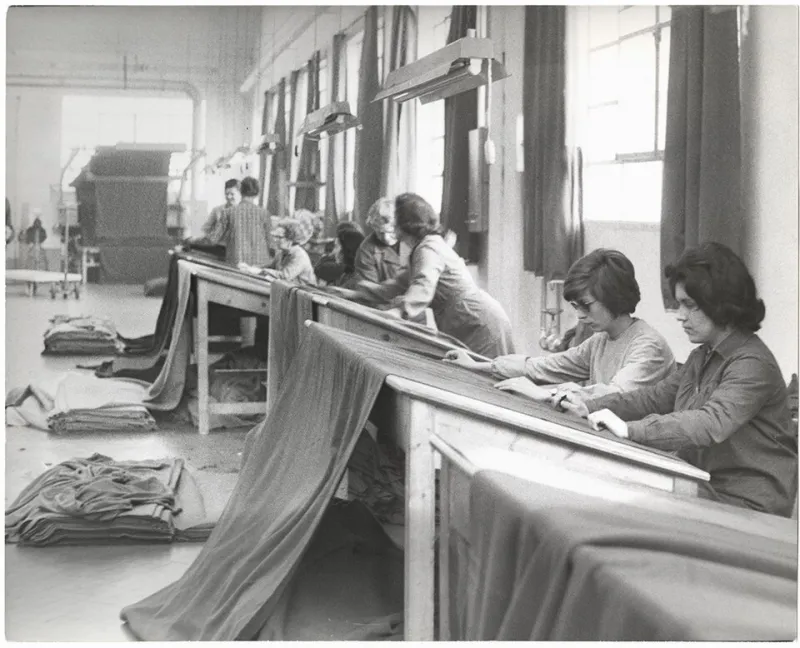
Photo: Unknown authorUnknown author, CC BY-SA 4.0, via Wikimedia Commons
For much of the last two decades, the phrase "supply chain" conjured images of sprawling logistics networks, anonymous factories, and the relentless pursuit of cost efficiency. For American luxury brands, however, a quiet but consequential counter-movement is underway. Rather than stretching their production pipelines ever thinner across distant continents, a discerning group of premium labels is drawing them shorter — routing them, with increasing deliberateness, through the workshops and mills of northern Italy.
This is not nostalgia. It is strategy.
The Geography of Quality
The Italian regions of Lombardy, Tuscany, and Veneto have long constituted something of a sacred geography for those who care about how garments are made. The silk weavers of Como, the leather tanners of Santa Croce sull'Arno, the wool spinners of Biella — these are not simply suppliers. They are custodians of craft traditions that predate the industrial revolution, families who have spent generations refining techniques that no algorithm has yet managed to replicate.
What has changed in recent years is the directness of the relationship between these artisans and their American counterparts. Where once a New York-based brand might have sourced Italian fabric through a network of agents, converters, and distributors — each layer adding cost, time, and opacity — a new generation of brand founders is traveling to Italy themselves, sitting across from mill directors, and negotiating agreements that eliminate the intermediaries entirely.
"When you walk the floor of a mill in Biella and watch a loom operator make a micro-adjustment by feel alone, you understand immediately why that cloth costs what it costs," said one New York-based menswear founder who recently transitioned his entire suiting fabric program to a direct partnership with a fourth-generation Piedmontese mill. "You also understand that there is no shortcut to it. The relationship has to be personal."
Resilience as a Luxury Proposition
The pandemic years exposed the fragility of extended, opaque supply chains with a clarity that no business school case study could have matched. American brands reliant on complex, multi-continent production networks found themselves unable to deliver product, unable to answer basic questions about provenance, and — perhaps most damaging for luxury positioning — unable to tell a coherent story about how their goods were made.
The Italian model offers a compelling corrective. Shorter supply chains are, by definition, more transparent. When a brand sources its cashmere from a single Umbrian spinner, has its cutting done in Florence, and oversees finishing through a trusted Milanese atelier, the provenance narrative is not a marketing construct. It is simply the truth.
This transparency has become, in itself, a form of luxury differentiation. Affluent American consumers — particularly those in the 35-to-55 demographic who have developed a sophisticated skepticism toward brand mythology — are increasingly drawn to labels that can account for every step of a garment's creation. They are not merely buying a jacket. They are buying a verifiable story.
The Economics of Proximity
Critics of the direct-Italy model are quick to note that proximity comes at a price. Italian labor costs are substantially higher than those in Southeast Asian manufacturing centers, and the minimum order quantities demanded by artisanal mills are often lower, complicating inventory planning for volume-dependent American retailers.
Yet the calculus is more nuanced than it first appears. Several brand executives interviewed for this piece noted that the reduction in intermediary fees, the elimination of costly quality-control failures discovered late in the production cycle, and the dramatic decrease in unsold inventory — a chronic hazard when lead times stretch to nine months or more — have meaningfully offset the higher per-unit costs of Italian production.
"We used to run markdowns every season because we were guessing six months out," noted the creative director of a women's ready-to-wear label that recently consolidated its production to three Italian partners. "Now our lead times are shorter, our quality is consistent enough that we rarely have returns, and our customers understand why the price point is what it is. The conversation has completely changed."
Sustainability Beyond the Buzzword
The ethical dimension of this realignment deserves equal consideration. The Italian manufacturing sector, particularly among its family-owned ateliers and mills, has long operated under rigorous labor standards enforced both by regulation and by the social accountability that comes with employing workers who live in the same village as the owner.
For American brands navigating an increasingly activist consumer landscape — one in which a single viral exposé can unravel years of brand equity — the ability to point to a supply chain rooted in Italian craft districts carries genuine reputational value. It is a form of due diligence that also happens to be aesthetically coherent.
Sustainability, in this context, extends to the longevity of the product itself. Garments produced with Italian fabrics and finished by skilled Italian hands tend, simply, to last longer. They develop that quality which the Italians call patina — a deepening of character with wear and age — rather than deteriorating into disposability. For a luxury brand, this is not merely a selling point. It is a philosophical statement about the purpose of what they make.
A New American Independence
There is a certain irony in the notion that American fashion independence might be achieved through deeper dependence on Italian craft. Yet the logic holds. By anchoring their production in relationships defined by transparency, skill, and mutual respect — rather than in the anonymous efficiency of globalized mass manufacturing — American luxury brands are building something that transcends supply chain management.
They are building a foundation.
The brands that will define American luxury in the coming decade will not be those that chased the lowest cost per unit. They will be those that had the patience to sit across from a mill director in Biella, to learn the name of the loom operator, and to understand that the cloth arriving at their New York atelier carries within it a history far older than any brand they could ever build.
That history, properly honored, is the most durable competitive advantage in fashion.